
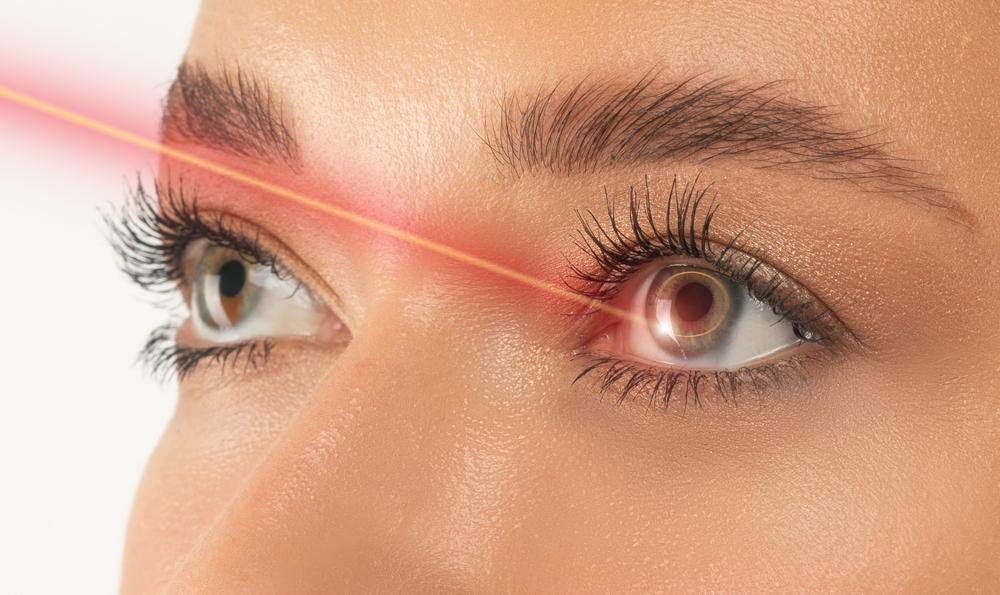
If you have severe nearsightedness, glasses and contact lenses may have been part of your daily routine for years. Refractive surgery can offer another option, but patients with high prescriptions may need to look beyond LASIK alone. At Grin Eye Care, we help Kansas City patients understand their vision correction options based on their prescription, eye health, and corneal anatomy.
Two procedures that may be considered for nearsightedness are EVO ICL and LASIK. While both are designed to reduce dependence on corrective lenses, they work in very different ways.
How Does LASIK Correct Nearsightedness?
LASIK is a laser vision correction procedure that reshapes the cornea so light can focus more accurately on the retina. At Grin Eye Care, we perform bladeless LASIK using advanced laser technology.
LASIK can be an excellent option for many patients with myopia, but candidacy depends on more than your prescription. We also evaluate corneal thickness and shape, tear film health, prescription stability, and your overall eye health.
For someone with severe nearsightedness, correcting a high prescription with LASIK may require removing more corneal tissue. If the cornea cannot safely accommodate the necessary correction, another type of refractive surgery may need to be considered.
What Is EVO ICL?
EVO ICL, or Implantable Collamer Lens, takes a different approach. Instead of reshaping the cornea, a thin corrective lens is implanted inside the eye while your natural lens remains in place. The lens works with your eye to correct moderate to high levels of nearsightedness and can also address certain levels of astigmatism.
Because EVO ICL does not rely on removing corneal tissue, it may be considered for some patients with high prescriptions or corneal characteristics that make LASIK less suitable.
EVO ICL vs. LASIK for Severe Nearsightedness
When Kansas City patients ask us about EVO ICL vs. LASIK, several factors help guide the discussion:
- Prescription strength: Higher levels of myopia may make EVO ICL worth considering.
- Corneal thickness: LASIK requires enough healthy corneal tissue for safe reshaping.
- Dry eye: Existing tear film problems can affect which procedure is appropriate.
- Eye anatomy: EVO ICL candidacy depends on measurements inside the eye.
- Age and prescription stability: Refractive surgery generally requires a stable prescription and healthy eyes.
- Personal goals: Lifestyle, visual expectations, and comfort with each procedure also matter.
Neither procedure is automatically the right choice simply because you have a strong prescription.
A Refractive Surgery Evaluation Provides The Answer
The most important step is a detailed examination. We evaluate your prescription, corneal shape and thickness, eye health, and other measurements before discussing which vision correction procedure fits your eyes.
For some Kansas City patients with severe nearsightedness, LASIK may still be appropriate. Others may benefit from discussing an implantable lens or another refractive surgery option. Our goal is to recommend an approach based on your individual eyes rather than applying the same procedure to every patient.
To explore your options for vision correction, contact Grin Eye Care in Kansas City, MO at (816) 333-8600 to schedule a refractive surgery evaluation.


